
From BMS Engineer to Apprentice: Lucy Tang’s Expanding Technical Path
GPG Women in Renewables Scholarship Recipient
Lucy Tang’s pathway at Airmaster has continued to evolve since she joined the ACT Automation & Energy team in 2022. With a background in telecommunications engineering and a Masters in Computing, she relocated to Australia to complete her studies before stepping into the building services industry.
Working as a BMS Engineer, she later chose to begin a Certificate III in Air Conditioning and Refrigeration alongside her role to strengthen her understanding of the systems she works on every day.
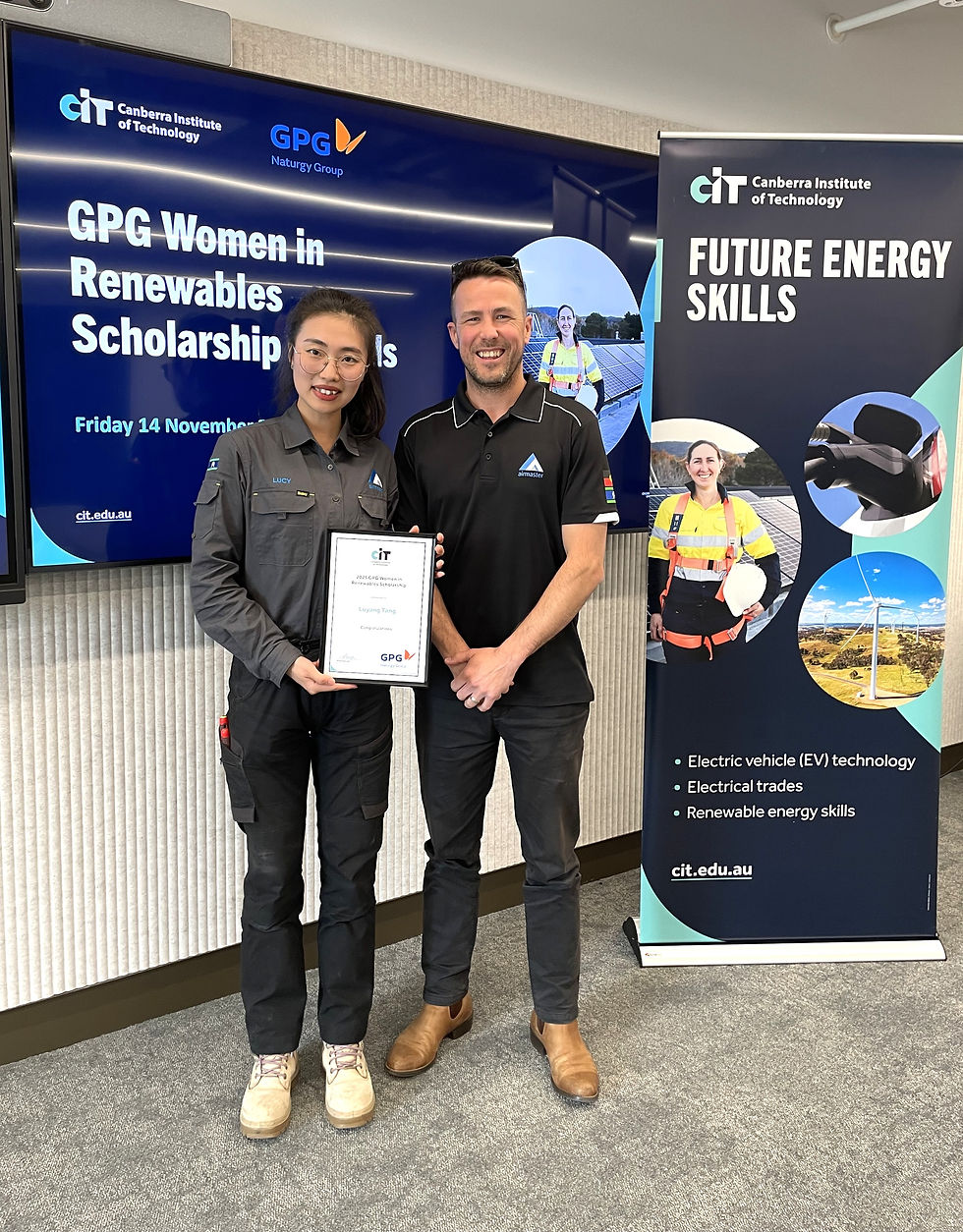
Last year, her commitment to extending her trade capability was recognised through the Women in Renewables Scholarship funded by Global Power Generation and delivered via the Canberra Institute of Technology. The scholarship supports women undertaking study in renewable energy and related technical fields and provides assistance for tuition and approved training costs.
Graeme Thors, Airmaster State Manager for ACT, says Lucy’s progression reflects both technical depth and consistency.
“Lucy brings strong technical capability and genuine dedication to developing her skills,” he says. “Taking on an apprenticeship while continuing in her engineering role shows focus and discipline. The scholarship recognises the effort she continues to invest.”
We asked Lucy to reflect on her journey so far, what led her to take on an apprenticeship, and what she hopes to build next.
Tell us about your story and career journey to date.
“I came to Australia in 2022, after the COVID lockdowns, to finish the final semester of my Masters degree in Computing. Three months after graduating, I joined Airmaster as a BMS Engineer. I was based at a prominent tertiary institution, working on building management system upgrades across multiple campus buildings.
After working as a BMS Engineer for a year at Airmaster, I recognised the importance of gaining hands-on knowledge in HVAC systems to complement my control and automation background. This motivated me to begin my apprenticeship so I could build a stronger foundation in the trade and broaden my career opportunities. Now I am both a BMS Engineer and a second-year apprentice. I’m really looking forward to finishing my apprenticeship and continuing to gain knowledge in this industry.”
What first sparked your interest in BMS and engineering?
“I would say it was a coincidence, but luckily I had a good opportunity to step into the HVAC industry. I completed my Bachelor of Telecommunications Engineering in China, and with my background in engineering, electrical knowledge, and computing and programming skills, my supervisor believed it would be easier for me to pick up HVAC technology through BMS work.
As I gained a deeper understanding of the industry and completed various projects, I found myself becoming more passionate about it and wanting to continuously improve my skills. That’s why I’m here now.”
Is your apprenticeship intended as an additional qualification, or something more essential?
“The apprenticeship is essential if I’m going to stay and make progress in this industry. My job requires me to understand HVAC systems and electrical components, as well as gain the restricted electrical licence needed to do commissioning and problem-solving work. It’s an essential certification, or I could say, a training program that everyone in this industry should complete.”
What does a typical day look like for you now?
“In the Automation & Energy team, I work on projects at a key tertiary institution. I build BMS databases, prepare documentation such as wiring diagrams and functional descriptions, and complete commissioning jobs or callouts.
“In the mechanical team, I work alongside senior technicians as an apprentice on maintenance, callouts, fault finding, and some installation work. It’s one thing to understand a system from the interface. It’s another to understand how the components operate in real life.”
Is there a particular task or challenge you’ve especially enjoyed so far?
“Critical buildings require precise temperature, humidity and pressure control, as well as detailed fault finding. I really enjoy that level of technical challenge.”
How has it been stepping into a trade where there are still fewer women?
“Stepping into a male-dominated trade has definitely pushed me out of my comfort zone, but that’s where growth happens. It has helped me develop resilience, communication skills, and confidence in my technical ability. I’ve found that once people see your competence, they show proper respect.
“I was not very confident when I first came to Australia. Everything was different, the culture and the language, and I was worried about whether I could get a job and how to fit into the company.
Even when I decided to start my apprenticeship, I felt nervous and scared. However, through working with different technicians, learning more and practising more, I now feel more relaxed and confident that I’m doing well and that I can do this job.”
Has anyone supported you on your journey so far?
“There are many people who have supported me on my journey. My team manager and team members. Our branch manager and department manager. The technicians at Airmaster I work with as an apprentice. My TAFE teachers and classmates. My partner and my family members.”
What were your thoughts when you found out you’d received the scholarship?
“I felt calm and at peace because I had a feeling that I would get this scholarship. I really appreciated the sponsors for providing this great opportunity and benefit. The application process is very simple. You download the form, complete it, and send it by email with the required supporting documents, then wait for the result.
"I attended the scholarship ceremony and met the sponsors. They were very supportive. I would suggest other women apply if there’s any chance, not only for financial benefit, but also as a good opportunity to gain confidence and meet more women in this industry.”
What are you hoping to achieve next in your career?
“I would like to become a lead designer and commissioning authority for more complex and larger jobs as a BMS Engineer. I would also like to gain more advanced BMS platform training and continue building experience in mechanical and maintenance fields and learn more about using tools.”
If you weren’t doing this, what kind of job could you see yourself doing?
“If I wasn’t working in this industry, I might continue in IT and data-related jobs because I have that background.”
What’s something most people wouldn’t guess about you?
“Most people wouldn’t guess that I’m completing a refrigeration apprenticeship while holding a Masters in Computing. I enjoy understanding systems from both the physical and data perspective.
I used to be quite shy when I started the job because I stepped into the industry with a totally different cultural background. Working in a male-dominated trade has really helped me develop confidence.”
Thinking about a career in engineering or the trades?
Lucy’s story shows how careers can develop in different ways. With the right support and a willingness to learn, there are opportunities to build your skills and grow into a pathway that suits your strengths.
At Airmaster, we are proud to support practical, hands-on career development across engineering, HVAC, automation and the trades.
If you're considering a future with Airmaster, you can view current roles on SEEK or register your interest via our Careers page.


Comments